New York Becomes First US State to Require Allergen Labels on Grab-and-Go Foods — November 12, 2026 Deadline
The Harckham-Lunsford Act (Section 1357) takes effect November 12, 2026, making New York the first US state to require written allergen labeling on food prepared and packaged on the same premises — covering deli counters, in-store bakeries, café grab-and-go sections, and food trucks.

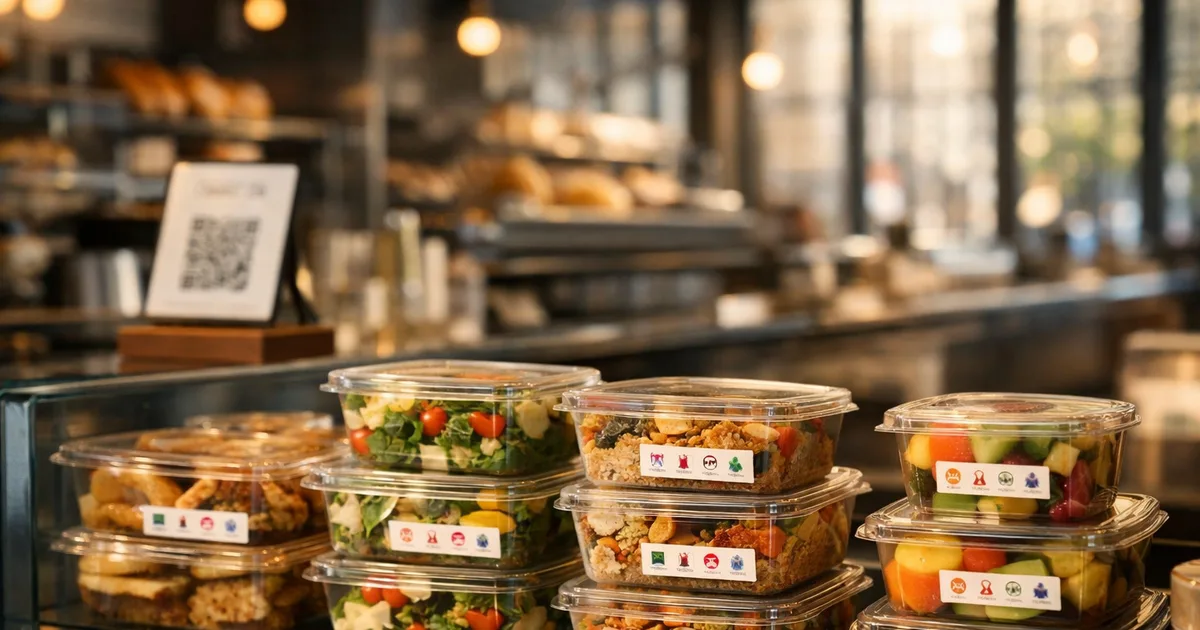
New York’s Harckham-Lunsford Act takes effect on November 12, 2026 — ten weeks from today. When it does, every food establishment in New York State that sells grab-and-go items, deli goods, or in-store bakery products packaged on the same premises will be required to label each package with written allergen information. New York becomes the first US state to extend mandatory allergen labeling beyond restaurant menus to food prepared and packaged on-site, according to Allergic Living’s reporting from November 2025.
TL;DR
- Law: Harckham-Lunsford Act (Section 1357, NY Agriculture and Markets Law), signed 12 November 2025; effective 12 November 2026
- Who: every New York food establishment selling premises-packed food — no size threshold, unlike California’s SB 68
- What: written notice of any of the nine FDA major allergens on each package or an attached label
- Excluded: food made to order immediately for a specific customer (a custom-made sandwich, a freshly plated dish)
- Minimum bar: a sticker with the allergen list is sufficient — no full ingredient list required
What “premises-packed” means — and what’s excluded
“Premises-packed” is the law’s operative term: food prepared and packaged at the same establishment where it is sold. According to reporting by Allergic Living, the category covers a wide range of standard food-service formats:
- Deli sandwiches or wraps assembled and cling-wrapped in advance for display
- Bakery items — cookies, muffins, pastries — placed in bags or boxes for self-selection
- Café grab-and-go salads, parfaits, and breakfast boxes packaged before service
- Buffet or deli items portioned and sealed in containers before a customer orders
The key distinction is advance packaging: items made fresh and handed to a specific customer at the moment of order are not premises-packed under the law. A sandwich assembled when a customer steps up to the counter is excluded; the identical sandwich sitting pre-wrapped in the cold display case is covered.
Food trucks that sell pre-packaged items are covered. Food trucks operating made-to-order only are not.
Who must comply — every food establishment, regardless of size
This is the sharpest difference between New York’s law and California’s SB 68. California’s Allergen Disclosure for Dining Experiences Act, which took effect July 1, 2026, applies only to restaurant chains with 20 or more locations. The Harckham-Lunsford Act has no chain-size threshold.
As NCCO’s foodservice compliance guide explains, a single-counter neighborhood deli, an independent café bakery, a large hospital cafeteria, and a multi-unit QSR chain are all subject to the same obligation: if they sell food prepared and packaged on the same premises, each package needs an allergen label by November 12.
The scope includes:
- Delis with grab-and-go sandwiches, salads, and prepared foods
- In-store bakeries selling pre-bagged pastries, cookies, and breads
- Cafés with refrigerated grab-and-go sections
- Supermarket and grocery food departments that prepare and package foods on-site
- Hotel and hospital food service with packaged grab-and-go options
- Food trucks with pre-packaged items for sale
Spencer Fane’s allergen regulation analysis notes that states are increasingly moving to close the premises-packed gap that federal law does not address — federal allergen labeling under FALCPA applies to manufactured packaged food sold interstate, not to food packaged at the point of sale.
What the label must show — and how simple the bar actually is
The compliance threshold is deliberately achievable. The label must identify which of the nine FDA-recognized major food allergens are present in the item: milk, eggs, fish, shellfish, tree nuts, peanuts, wheat, soybeans, and sesame.
According to NCCO’s guide:
- A sticker reading “Contains: peanuts, wheat, milk” attached to the packaging is sufficient for compliance.
- No full ingredient list is required — only the allergen identification.
- The notice must appear on the package itself or on an attached label — a general allergen chart posted on the wall or a sign near the display case does not satisfy the requirement.
- If an item contains none of the nine major allergens, no label is required (though some operators choose to include an “allergen-free” note as a positive signal to customers).
For independent operators, this translates to a practical workflow: build an allergen reference for each grab-and-go recipe, then source pre-printed labels or a thermal label printer. Just Allergy Things notes that several label-supply vendors have developed allergen-disclosure label kits specifically for the New York market.
How this fits the wider US state allergen wave
New York’s law extends a legislative pattern that has been accelerating since 2025. As our US allergen regulation tracker documents, restaurant-menu allergen disclosure laws are advancing in at least five additional states. The Harckham-Lunsford Act fills a parallel gap — packaged food at the same site — that menu-level legislation does not address.
| State | Law or Bill | Scope | Status | Effective date |
|---|---|---|---|---|
| California | SB 68 (ADDE Act) | Chain restaurants (20+ locations) — menus | In effect | 1 Jul 2026 |
| New York | Harckham-Lunsford Act | All food establishments — premises-packed food | Signed — 10 weeks to go | 12 Nov 2026 |
| Maryland | HB 181 | All restaurants — menus | Introduced Jan 2026 | Oct 2026 (if enacted) |
| New Jersey | SB 3394 | All restaurants — menus | Introduced Feb 2026 | TBD |
| Michigan | HB 5402 | All food service permit holders | Introduced Dec 2025 | TBD |
| Illinois | HB 4686 | All restaurants | Introduced early 2026 | Jan 2028 (if enacted) |
Spencer Fane notes that the trajectory is consistent: written, per-item allergen information is becoming the baseline expectation for US food service, and each new state law tends to widen the scope relative to what came before.
What to do before November 12
Step 1 — Audit your grab-and-go inventory. List every item you sell pre-packaged. For each one, map it to a recipe and identify which of the nine major allergens appear. This is the foundational work; everything else follows from it.
Step 2 — Source a labeling system. Pre-printed label rolls keyed to your menu items are the simplest path for small operators. A thermal label printer with per-item templates works well for rotating menus. Either way, the label must be applied before the item goes in the display case.
Step 3 — Train packaging staff. The person wrapping the item is the last line of defense before it reaches a customer. Training should cover which label applies to each item and how to handle recipe changes that affect allergen content.
Step 4 — Document your process. While the law specifies labels, not documentation, having a written allergen log per menu item is the clearest evidence of good-faith compliance and the fastest way to update labels when a recipe changes.
For restaurants that already use a digital QR menu to manage per-dish allergen data, that same ingredient database is the natural starting point for the grab-and-go label program. Knowing what allergens are in each recipe is the shared foundation for both compliance channels. Our guide on how QR menus handle allergen disclosure walks through how digital menus anchor a restaurant’s broader allergen management system.
To tag per-dish allergen information live on your menu today — updatable the moment a recipe changes — you can start a free ShevaFood account and have allergen disclosures active before the November deadline.
Allergen disclosures on every dish, live from today
For a full picture of how digital QR menus work end to end, see our Complete Guide to QR Code Menus for Restaurants.
Frequently Asked Questions
Premises-packed food is any item prepared and packaged at the same location where it is sold — for example, a deli sandwich wrapped in advance, a bakery item in a bag, or a café salad in a sealed container. Food made to order immediately after a customer requests it (a custom sub, a freshly assembled plate) is excluded from the definition. The trigger is the advance packaging, not where the food was made.
Unlike California’s SB 68, which covers only chains with 20 or more locations, New York’s law applies to every food establishment in the state regardless of size. A single deli, an independent bakery, a food truck, or a large chain must all comply by November 12, 2026 — there is no minimum-location threshold.
The label must identify any of the nine FDA major allergens present in the food: milk, eggs, fish, shellfish, tree nuts, peanuts, wheat, soybeans, and sesame. A sticker reading “Contains: peanuts, milk, wheat” attached to the package is sufficient. The law does not require a full ingredient list — only allergen identification.
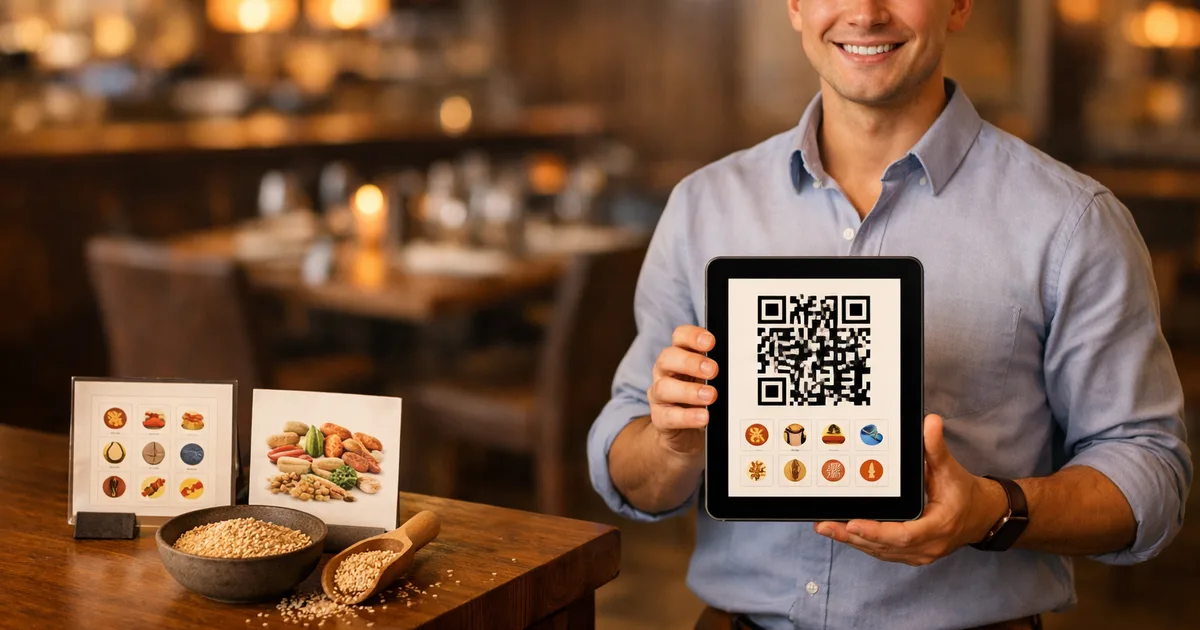
No — not for premises-packed items. The law requires a physical label on the package itself or attached to it. A QR code can supplement the label but cannot replace the written physical label for packaged grab-and-go foods. For sit-down restaurant menus, digital QR menus remain a valid allergen disclosure format under separate guidance such as California’s SB 68.
Build or audit an allergen inventory for every grab-and-go item you sell — identify which of the 9 FDA major allergens appear in each recipe. Source a labeling system (pre-printed stickers or label printers). Train staff responsible for packaging to apply the correct allergen label before items go into the display case. Ten weeks is sufficient time to get this in place if you start the recipe audit now.
Sources
- NY Law Brings Allergen Labeling to Deli, Bakery Packaged Foods — Allergic Living , 13 November 2025
- NY Allergen Labeling Law 2026: Foodservice Guide — NCCO
- New York Becomes First State to Require Allergen Labels on Prepackaged Foods — Just Allergy Things
- Additional Legislation Expected to Mandate Food Allergen Disclosures for Food Establishments — Spencer Fane
- New York Food Safety Laws: The Complete 2026 Compliance Guide — ServingAlcohol.com
Tags
Related Articles
Virginia's Updated Allergen Rules Are Live — Sesame Added and QR Codes Approved for All Food Establishments

Delivery Hero's AI Agent Boosted Restaurant Orders by 15% — And It Runs on WhatsApp