US Restaurant Allergen Laws 2026: California's July Deadline and the State-by-State Wave
California SB 68 is weeks from its effective date, New York signed a parallel allergen law in November 2025, and Michigan and Illinois have bills advancing. A state-by-state allergen disclosure wave is reshaping what written menu compliance means for US restaurants.

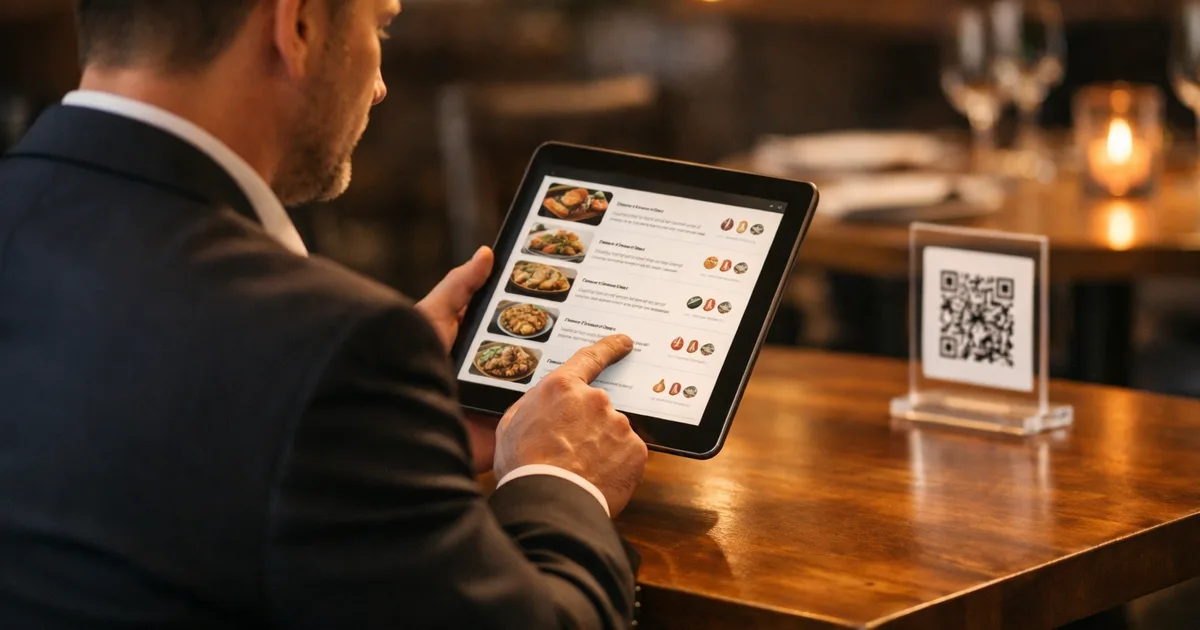
California’s Allergen Disclosure for Dining Experiences Act (SB 68) takes effect on 1 July 2026, requiring restaurant chains with 20 or more US locations to provide written allergen disclosures for every menu item — and explicitly accepting a digital menu or QR code as a valid way to comply. California Governor Gavin Newsom signed the law on 13 October 2025, making California the first US state to mandate per-item allergen disclosure at chain restaurants. In the weeks that followed, New York signed a parallel allergen labeling law for packaged deli and bakery foods, and bills advancing in Michigan and Illinois would extend similar requirements to every restaurant — not just large chains.
TL;DR
- California SB 68 (effective 1 July 2026) requires chains of 20+ locations to list all 9 major US allergens in writing per menu item; digital menus including QR codes satisfy the requirement when a non-digital option is also offered.
- New York’s allergen law (signed 12 November 2025, effective November 2026) requires allergen labels on pre-packaged foods at delis, bakeries, and food trucks — a separate obligation from the California rule, covering different food service contexts.
- Michigan HB 5402 and Illinois HB 4686, introduced in late 2025 and early 2026, would remove the chain-size threshold and require written allergen disclosure from every food service establishment.
- The direction is consistent: written allergen information on menus is moving from best practice toward law, following the same trajectory that Europe took between 2014 and 2021.
What California SB 68 requires — and who it covers
California SB 68 applies to food facilities already subject to federal menu-nutrient labeling under the Affordable Care Act — broadly, chains with 20 or more locations in California operating under the same name and offering substantially the same menu items. According to legal analysis by ArentFox Schiff, these operators must provide written notification of the nine major US food allergens — milk, eggs, peanuts, tree nuts, fish, shellfish, wheat, soy, and sesame — that they know, or reasonably should know, are present in each menu item.
The disclosure can appear on a physical menu or on a digital menu, including via QR code. One condition applies: a non-digital alternative must be available for guests who cannot access a smartphone. The law also brings California in line with the federal FASTER Act by formally adding sesame as the ninth major allergen.
Fisher Phillips has published a detailed eight-step compliance guide for affected chains. The short version: identify every ingredient that contains a major allergen, map that data per menu item, and publish it in writing by July 1.
Single-location independent restaurants are not covered — yet. But that carve-out is already under pressure from the bills below.
New York: allergen labels for delis, bakeries, and food trucks
A month after SB 68 was signed, New York Governor Kathy Hochul signed the Harckham-Lunsford bill into law on 12 November 2025. The law amends New York’s Public Health Law and Agriculture and Markets Law to require allergen labeling on food packaged on the premises at cafeterias, delis, bakeries, sandwich shops, food trucks, and hotel food outlets.
As Allergic Living reported the day after signing, the requirement applies to food that is pre-packed before a customer orders — a wrapped deli sandwich, a boxed bakery item — not to food cooked to order at a table. That distinction keeps full-service sit-down restaurants outside this particular obligation. The law covers all nine major allergens and takes effect November 2026.
The gap it fills is meaningful: a customer picking up a pre-made wrap at a hospital cafeteria or airport deli has historically received no written allergen notice, because federal labeling rules cover only commercially packaged goods sold in retail stores — not food packaged on site.
Michigan and Illinois: the states watching California
California’s model is already spreading. A February 2026 Allergic Living analysis and a detailed Spencer Fane legal briefing identified two active bills that would drop the chain-size threshold entirely.
Michigan HB 5402 (introduced December 2025) would require all food service permit holders — not just chains — to provide written notification of major allergens for unpackaged food items, deliverable by physical or electronic means including brochures, menus, placards, or digital displays.
Illinois HB 4686 (introduced February 2026) would require every restaurant, regardless of size, to include “clear and conspicuous notices” of allergens on all physical, digital, or online menus. Non-compliance would carry a $500 fine per menu item. If enacted, the law would take effect 1 January 2028.
Neither bill has yet been signed into law, but both signal that California’s 20-location threshold is a starting point for legislative momentum rather than a stable ceiling.
Why the direction matters for every restaurateur
For covered California chains, July 1 is a hard compliance date — four weeks out. For every other operator, the trajectory is unambiguous: written, per-dish allergen information is becoming the baseline expectation in US food service, mirroring the path the EU and UK took over the past decade. (For the UK side of this story — including how the Food Standards Agency’s spring 2026 review could push Owen’s Law forward — see our earlier report, Written Allergen Menus Move Closer in 2026.)
The practical implication cuts across all restaurant sizes: you need a way to document allergen data per dish and surface it to guests in writing — and keep it current when recipes or suppliers change. A digital menu makes the written half of this easier to sustain: tag each dish’s allergens once, and every guest sees accurate information on every device. If a recipe changes, one update propagates everywhere, with no reprinting required.
Written allergen information should always sit alongside a conversation with at-risk guests, not replace it — California’s law and best practice both make this clear. The software handles the written record; your team handles the conversation.
What to do now
- California chain operators: confirm written allergen data is in place for every menu item before 1 July 2026. Digital menus (including QR) are accepted — add a printed fallback.
- New York food businesses with deli, bakery, or grab-and-go items: audit packaging labels for all nine major allergens; compliance required by November 2026.
- All restaurateurs: start building per-dish allergen records now, before any law requires it — the legislative trend is consistent and the compliance window is shorter than it appears.
- Multi-state operators: monitor Michigan and Illinois; if either bill is enacted, chain-size thresholds will no longer define who must comply.
If you want allergen information live on your digital menu today — tagged per dish, visible in 16 languages, and updated instantly when a recipe changes — you can start a free ShevaFood account and have it running before your next service.
Put allergens on every dish, in every language
For a full overview of how dynamic QR menus work end to end, see our Complete Guide to QR Code Menus for Restaurants.
Frequently Asked Questions
No. SB 68 covers only food facility chains with 20 or more locations in California operating under the same name and offering substantially the same menu — the same size threshold as federal menu-nutrition labeling rules. Single-location independent restaurants are not covered by this specific law, though pending state bills in Michigan and Illinois would remove that threshold entirely.
Yes. SB 68 explicitly allows the written allergen disclosure to appear on a digital menu, including via QR code, as long as a non-digital alternative (a physical menu or printed notice) is also available for guests without a smartphone. Both formats must be offered simultaneously.
New York’s law (signed November 2025, effective November 2026) covers food packaged on the premises at delis, bakeries, food trucks, and cafeterias — food pre-packed before a customer orders. California’s SB 68 applies to full-service chain restaurant menus, covering food cooked or assembled to order. The two laws target different points in the food-service chain and can apply to the same operator at the same time.
As of early 2026, Michigan’s HB 5402 would require written allergen disclosure from all food service permit holders regardless of chain size, and Illinois’s HB 4686 would mandate allergen notices on every restaurant menu from 2028 if passed. Additional states are monitoring California’s implementation closely before advancing their own bills.
Audit allergen data per menu item for all nine major US allergens, choose a compliant format (physical menu, digital menu, or QR code with a non-digital fallback), and confirm every update is live before July 1. Consulting a food-and-beverage attorney for state-specific enforcement guidance is strongly advised for multi-location operations.
Sources
- SB-68 Major food allergens (Allergen Disclosure for Dining Experiences Act) — California Legislative Information , 13 October 2025
- California Enacts First-in-the-Nation Allergen Disclosure Law for Restaurant Chains — ArentFox Schiff
- Many Restaurant Chains Must Comply with California's New Allergen Disclosure Law: Here's Your 8-Step Plan — Fisher Phillips
- Harckham, Lunsford Bill Requiring Allergen Labeling for Prepackaged Foods Signed into Law — New York State Senate , 12 November 2025
- NY Law Brings Allergen Labeling to Deli, Bakery Packaged Foods — Allergic Living , 13 November 2025
- Additional Legislation Expected to Mandate Food Allergen Disclosures for Food Establishments — Spencer Fane
- Restaurant Allergen Bills Introduced in 3 States, How You Can Help — Allergic Living , 18 February 2026
Tags
Related Articles
Virginia's Updated Allergen Rules Are Live — Sesame Added and QR Codes Approved for All Food Establishments
New York Becomes First US State to Require Allergen Labels on Grab-and-Go Foods — November 12, 2026 Deadline