Google Maps Just Became a Food Ordering Agent: What Ask Maps Means for Restaurants
Google Maps' Ask Maps can now order takeout end-to-end: users prompt the assistant in natural language, and it assembles the cart on Square or Toast (Uber Eats coming) before handing over for payment. Google also announced a Universal Commerce Protocol for Food. For restaurants without a live, structured menu, the second major AI-ordering channel of the summer has just opened — and closed.
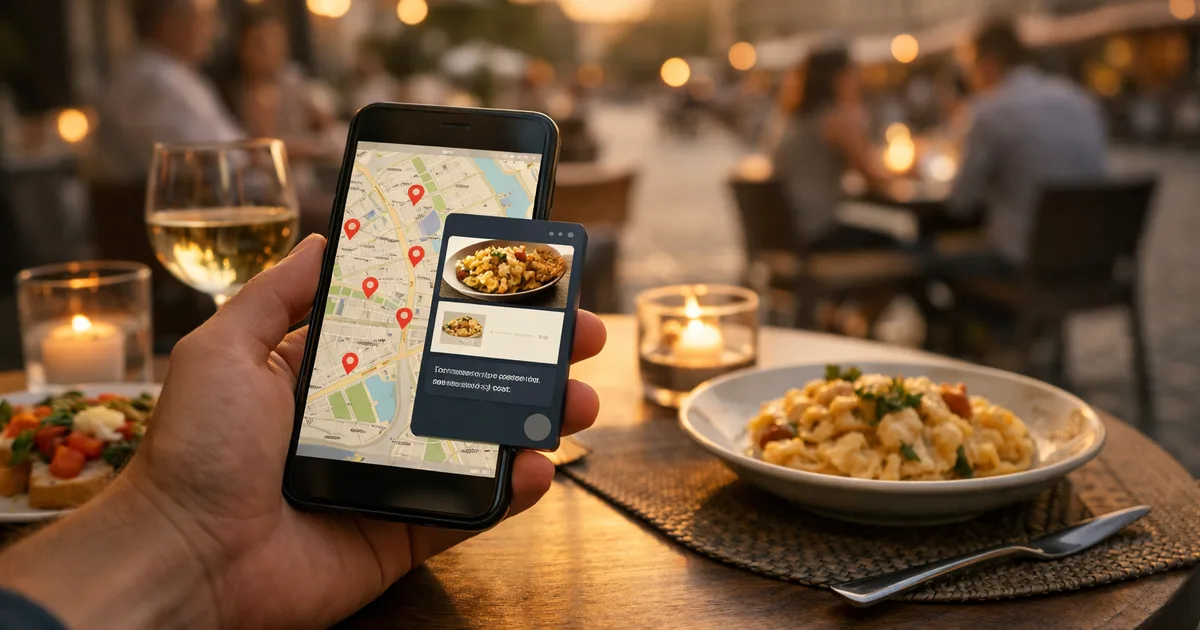
On 6 August 2026, Google announced that Ask Maps — the Gemini-powered conversational assistant inside Google Maps — can now order takeout end-to-end. A diner prompts Ask Maps in natural language; the assistant picks a nearby restaurant, adds the requested dishes to a cart on that restaurant’s ordering platform, and hands the cart back to the user to pay. Launch partners are Square and Toast, with Uber Eats support named as “coming soon.” The same update added agentic hotel booking, event-ticket discovery, Personal Intelligence tied to Gmail and Calendar, and rollout to Australia, Brazil, Canada, Indonesia, Japan and Mexico, plus over 150 countries in English.
What changed at a glance:
- 6 Aug 2026 — Google adds agentic food ordering, hotel booking and events to Ask Maps (Google blog; TechCrunch)
- Food ordering runs on Square and Toast at launch; Uber Eats is next (Engadget)
- Google announced a co-developed Universal Commerce Protocol for Food — an open spec for how an AI agent talks to a restaurant menu and cart (Food On Demand)
- Ask Maps launched in the US and India in March 2026; the 6 August update rolls it out to six more markets and 150+ English-language countries (Engadget)
- Second major AI-ordering channel of the summer, after Square’s 1 July ChatGPT and Claude launch
How Ask Maps orders food for a diner
A user prompts Ask Maps in plain language — Google’s demo example is “order spicy pad kee mao with seafood for me to pick up on my way home” — and the agent handles discovery and cart assembly. Ask Maps identifies a nearby restaurant, adds the requested dishes to a cart on the restaurant’s ordering platform, then hands the completed cart to the diner for review and payment on that platform. Maps runs the discovery and the cart; the platform handles the transaction.
That split matters. Ask Maps is not a delivery marketplace and does not carry its own payment layer for food orders. It sits on top of the restaurant’s existing ordering platform — Square or Toast today, Uber Eats next — and drives traffic and structured intent into it. In practice, that means the AI channel inherits whatever pickup, delivery, fees and menu accuracy the underlying platform already provides.
The Universal Commerce Protocol for Food
Alongside the launch, Google said it will co-develop a Universal Commerce Protocol for Food with its partners — an open specification for how an AI agent talks to a restaurant’s menu and cart. If it lands, ordering platforms would speak a common language to AI agents, so a restaurant that structures its menu once could be reachable by any agent that implements the spec — Gemini today, other AI assistants tomorrow — without a bespoke integration per channel.
The economic implication is straightforward: structured menu data becomes an even more valuable asset when it is portable across AI channels, not locked to any one of them. It also strengthens a pattern already visible with Square’s own July launch — that operators keep the customer relationship and payment on their own stack, while the AI assistant becomes a discovery-plus-cart layer on top.
Why this matters: the second AI-ordering channel of the summer
Google Maps’ agentic ordering is the second major AI ordering channel to launch in six weeks — and both share the same restaurant-side requirement. Square opened ChatGPT and Claude to its US F&B sellers on 1 July 2026 with auto-enrolment for anyone running Square Online Ordering. Six weeks later, Google Maps became an ordering agent for Square and Toast operators, with Uber Eats set to follow.
The shipped ai-restaurant-discovery-2026 piece documented the visibility gap — Uberall’s May 2026 benchmark that 83% of restaurants receive zero AI-generated recommendations despite being on Google. What is happening now is the second stage of the same shift: visibility is table stakes; being orderable through an AI agent is the new distribution frontier. In parallel, AI has moved inside the menu itself, from generative descriptions to pricing agents. The through-line is the same: a live, structured digital menu is the base layer everything else depends on.
Personal Intelligence in Ask Maps sharpens the point. When the assistant can read a diner’s Gmail confirmations and Calendar to personalise a dinner suggestion, the recommendation window narrows to a handful of restaurants — the ones whose menu, hours, allergen tags and current specials are machine-readable enough for the agent to act on.
What restaurants need to be ready
The technical prerequisite is not new; the stakes are. To be reachable through Ask Maps’ agentic ordering today, a restaurant needs an active ordering profile on one of the launch platforms (Square or Toast; Uber Eats coming) with a current, structured menu — dishes, descriptions, prices, modifiers, allergen tags, availability windows — kept up to date in that platform. A static PDF menu behind a QR code, or a stale third-party listing, is not machine-readable in the way Ask Maps needs; it might still surface in a search result, but the ordering flow will skip it.
The same requirement is also the foundation of a modern QR code menu: a live, structured menu that the operator controls, not a printed page frozen at print time. Whether the front door is a QR sticker on the table, a ChatGPT prompt, a Claude conversation, or now an Ask Maps question, the back-end asset that makes any of it work is the same. Multilingual coverage — 16-language menus, in ShevaFood’s case — becomes the visible edge when Ask Maps expands to non-English markets and diners phrase orders in Portuguese, Japanese or Indonesian.
Your menu is your AI storefront — make it structured and live
Three things this launch tells operators
-
Two AI ordering channels in six weeks is a pattern, not a one-off. Square/ChatGPT/Claude on 1 July, then Google Maps/Square/Toast on 6 August, with Uber Eats named as next. Every operator should expect at least one more AI-ordering entry point before year-end — the question is whether their menu is ready to plug into it.
-
Structured menu data is now cross-channel infrastructure. The Universal Commerce Protocol for Food, if it lands, formalises what is already true — an AI agent needs a machine-readable menu to act on. Every dish without a description, every price that lives only on a printed PDF, is a blind spot across every AI channel at once.
-
The QR code menu is no longer just customer-facing. A live, structured digital menu — the same asset a diner scans at the table — is now the eligibility card for AI ordering. Restaurants that treat their menu as a static document risk being visible in search yet invisible in the ordering flow that follows the search.
FAQ
What is Ask Maps and what did it gain on 6 August 2026?
Ask Maps is Google Maps’ Gemini-powered conversational assistant, launched in the US and India in March 2026. On 6 August 2026 Google added agentic food ordering (via Square and Toast, with Uber Eats coming), hotel discovery, event ticketing and Personal Intelligence — an option for the assistant to draw on the user’s Gmail and Calendar to personalise its answers.
How does Google Maps agentic food ordering actually work for a diner?
The diner asks Ask Maps in plain language — for example, “order spicy pad kee mao with seafood for me to pick up on my way home.” Ask Maps selects a nearby restaurant, adds the requested dishes to a cart on that restaurant’s ordering platform (Square or Toast), and hands the cart off for the diner to review and pay for on that platform. Maps handles discovery and the cart; the platform handles payment.
How does a restaurant get into Google Maps’ agentic food ordering?
There is no separate signup. A restaurant is eligible if it takes orders through a launch-partner platform — Square or Toast at launch, Uber Eats coming — and has a current, structured digital menu on that platform. Restaurants whose only “digital menu” is a static PDF behind a QR code, or a stale third-party listing, are not reachable by Ask Maps’ ordering flow even if they appear in a search result.
What is the Universal Commerce Protocol for Food that Google announced?
It is an open specification Google says it will co-develop with partners so an AI agent can talk to any restaurant’s menu and cart in a standard way. If it lands, ordering platforms would speak a common language to AI agents — reducing the risk that each new channel (ChatGPT, Gemini, others) requires its own bespoke integration and making structured menu data the shared foundation across them.
How is this different from Square’s July 2026 ChatGPT and Claude launch?
Square’s 1 July integration turned ChatGPT and Claude into ordering surfaces for Square F&B sellers. Google Maps’ 6 August update turns Maps itself — and its Gemini assistant — into an ordering agent, running on Square and Toast today with Uber Eats to follow. They are complementary channels: the same underlying requirement (a live, structured digital menu) unlocks both.
Where is Ask Maps available today?
Google says Ask Maps launched in the US and India in March 2026 and is now expanding to Australia, Brazil, Canada, Indonesia, Japan and Mexico, plus more than 150 countries in English. Feature availability by market may lag the language rollout — the food-ordering agent, for instance, depends on which ordering platforms operate in each country.
Google Maps’ agentic food ordering was announced on 6 August 2026 (Google’s Keyword blog). Launch-partner details, protocol name and country rollout are drawn from Google’s announcement and independent reporting by TechCrunch, Engadget, TechRepublic and Food On Demand. This article will be updated as Uber Eats support goes live and as Ask Maps food ordering expands beyond its launch markets.
Sources
- Ask Maps gets more helpful with food ordering — The Keyword — Google (official) , 6 August 2026
- Google Maps adds agentic features, including food ordering and hotel bookings — TechCrunch , 6 August 2026
- Now you can chat with Google Maps to order food, reserve hotels and more — Engadget , 6 August 2026
- Google Maps Launches Agentic Ordering Feature with Square, Toast, Uber Partnerships — Food On Demand , 12 August 2026
- Google Maps Gets New Gemini Agent Features for Orders, Hotels, and Events — TechRepublic , August 2026
- Google Maps' Ask Maps now lets users order food conversationally — TechBriefly , 7 August 2026
Tags
Related Articles
Virginia's Updated Allergen Rules Are Live — Sesame Added and QR Codes Approved for All Food Establishments
New York Becomes First US State to Require Allergen Labels on Grab-and-Go Foods — November 12, 2026 Deadline